
In most climbing gyms, the busiest spot on a weekday evening is no longer the lead wall or the main bouldering area. It's the board. Climbers who have never met trade beta, film each other's attempts and stay far longer than they planned.
An adjustable board is made of two parts:
1. The frame
An articulated structure whose angle is set by actuators. The same panel goes from a technical slab to a steep overhang.
2. The system
What's mounted on the panel: a connected board such as the Tension Board, Kilter Board, MoonBoard or So iLL, where each hold has its own LED and problems light up from an app, or loose holds for a spray wall.
Most buyers compare systems. Yet it's the frame that decides how the wall climbs, how long it lasts and what it can become.
Adjustable boards on the market: what are the options?
Boards with a proprietary LED system
e.g. Walltopia Quantum Board
- Angles from 25° to 60°: no slab, no vertical.
- Built around the brand’s own holds and app.
Motorized multi-system frames
e.g. Walltopia Adjustable Board, Piton Board
- Electric actuators, or an electric motor with straps.
- Angles from 10–15° to 70°: they always stay in overhang.
- Compatible with several connected systems.
Fixed-angle boards
e.g. MoonBoard
- No motor: the wall is built at 25° or 40°.
- One system only.
- One angle for everyone, too steep for most gym members.
Manually adjustable walls
Mostly home and entry-level walls
- Hand winch or mechanical adjustment.
- Too slow to change the angle between two climbers in a busy gym.
Lemur frames: what sets them apart
A wall that doesn’t move under you
On a board, you feel every bit of flex: the panel shifts on a hard move, footholds feel vague, and the same problem never climbs the same way twice. The MKIII frame has been reinforced to keep the panel flat and still at every angle, from slab to full overhang.
True slab
The Original Wall starts at +5° slab, below vertical, and goes up to 70°. Lemur is the first adjustable frame to go below vertical.
The only adjustable Slab Wall
Lemur is the only manufacturer to offer an adjustable spray wall built for slab, from +10° to 40°.
Your system, your call
Tension, Kilter, Moon, So iLL, spray wall, or any other board app on the market.
Lemur’s 2 adjustable climbing walls
Both walls run on the MKIII frame, are CE, CSA and UL certified, install in one day without specialized tools, and work on any voltage from 100 to 240 V.
MKIII frame CE · CSA · UL 1-day install 100–240 V
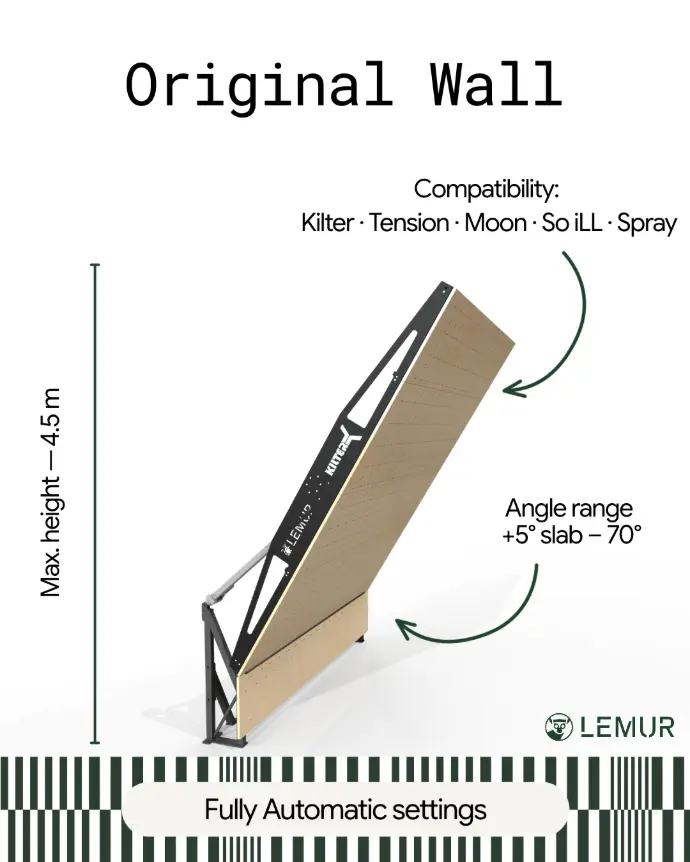
Slab Wall: Adjust. Spray. Repeat.
Your wall, your holds, your rules.
- Use it as a spray wall, with a high density of holds so everyone can create their own lines, or as a boulder wall with problems set by your team.
- Angle from +10° slab to 40° overhang: a range focused on technique, footwork and route reading rather than pure strength.
- Fully automatic or assisted adjustment, your choice.
- Buy the holds from the supplier of your choice, or through Lemur’s network of resellers.
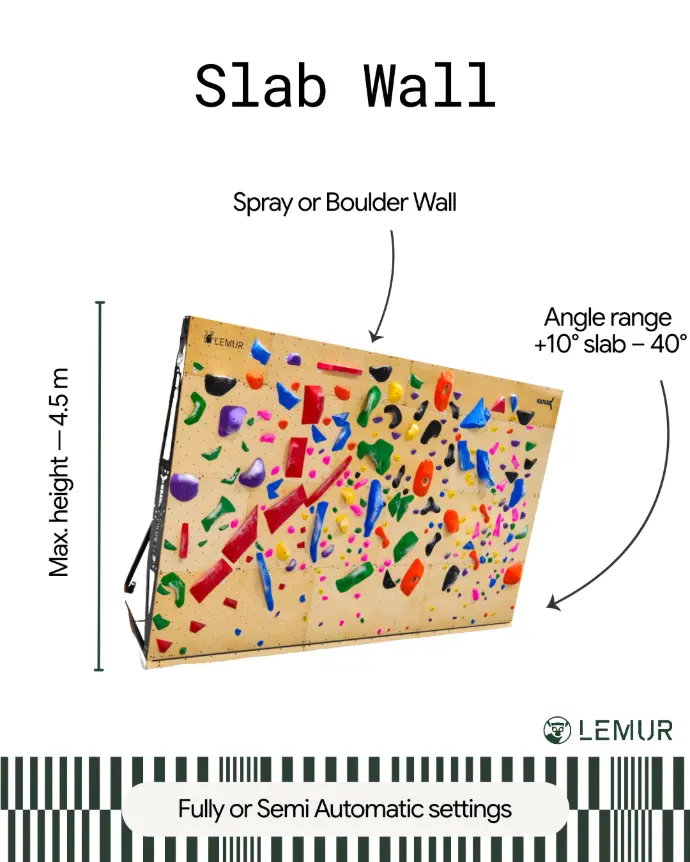
Original Wall: one wall, every angle
Designed for connected training boards.
- Angle from +5° slab to 70° overhang: low angles for footwork and beginners, mid angles for bouldering, the steepest for strength and core training.
- Compatible with Kilter, Tension Board, Moon and So iLL, or set up as a spray wall.
- Fully automatic adjustment: select the angle on a touchscreen, with built-in safety features such as tilt limits.
- The centerpiece of a board room, the space that brings climbers in and keeps them coming back.
The two walls compared
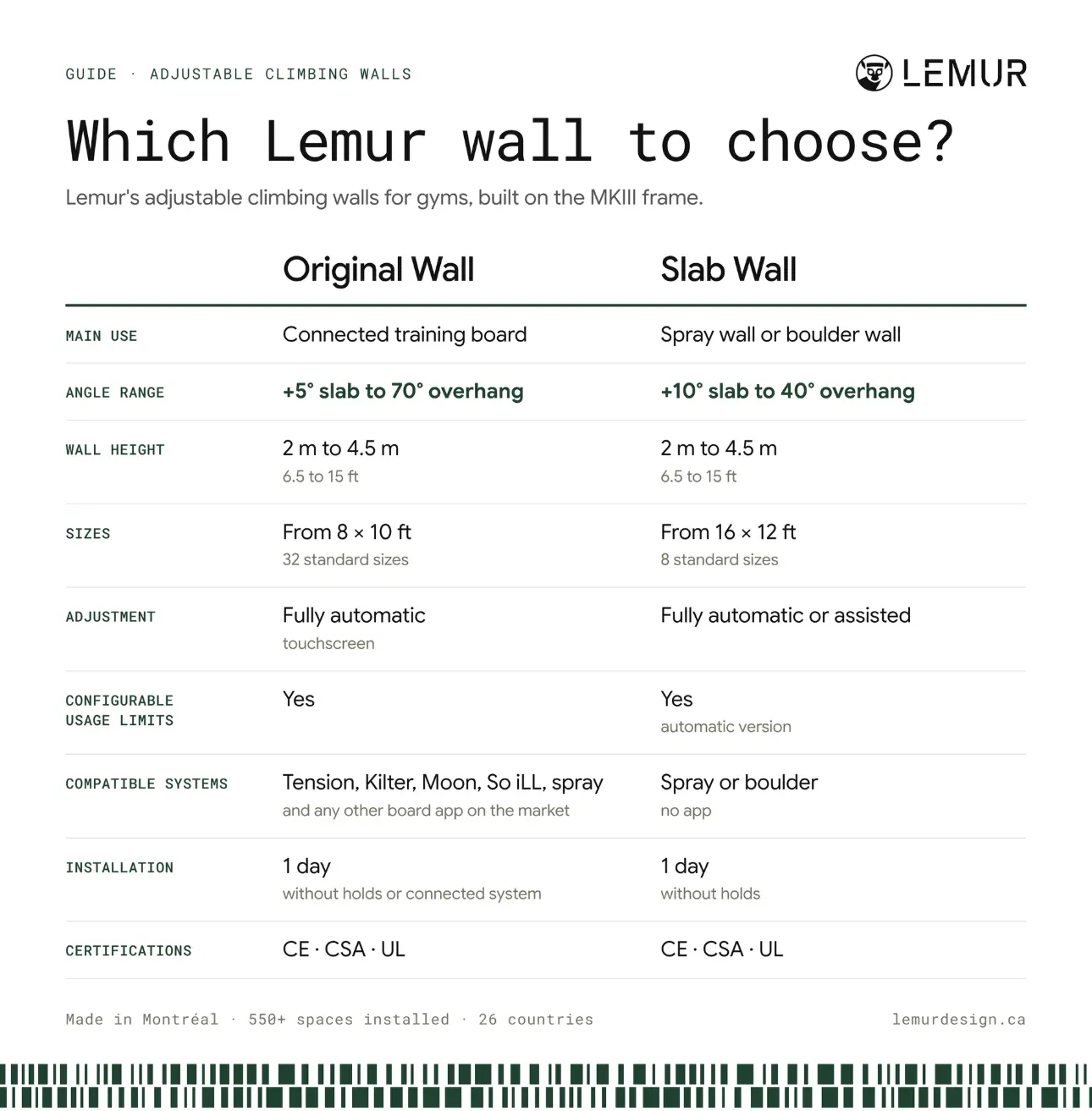
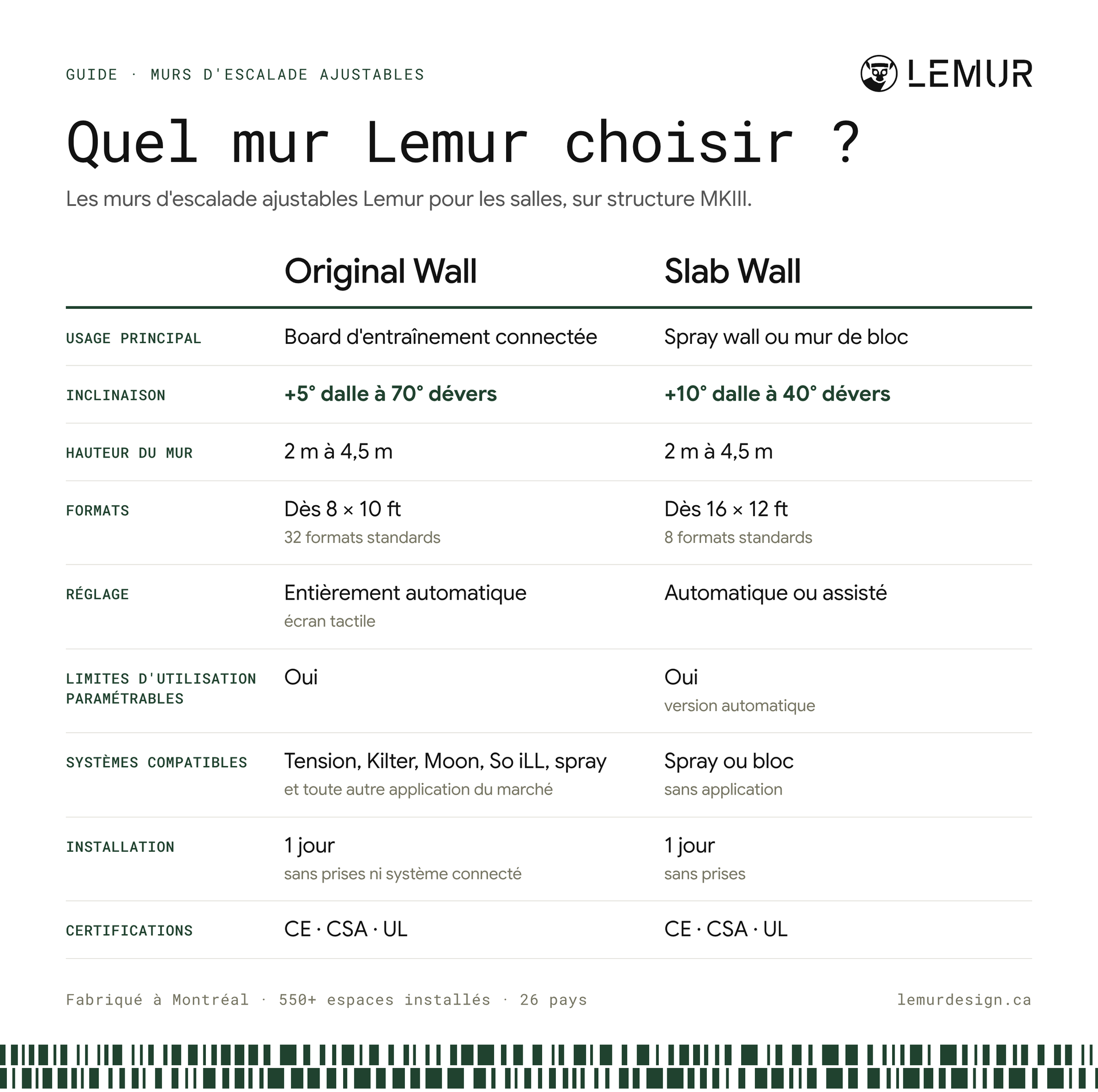
Not sure which wall fits your space?
Send us your floor area and ceiling height. We reply within 24 hours.